Table of Contents
Every stage of pregnancy has its own set of anatomical and medical marvels, along with its own set of anxieties! In the third trimester, the maternity care team starts tracking the baby’s position in the uterus. The word “breech position” can naturally cause concern for an expectant mother.
Learning about breech presentation in pregnancy, why it happens, and the option can offer to the mother in such cases makes the last stretch of pregnancy smoother and more uncomplicated.
What is Breech Presentation?
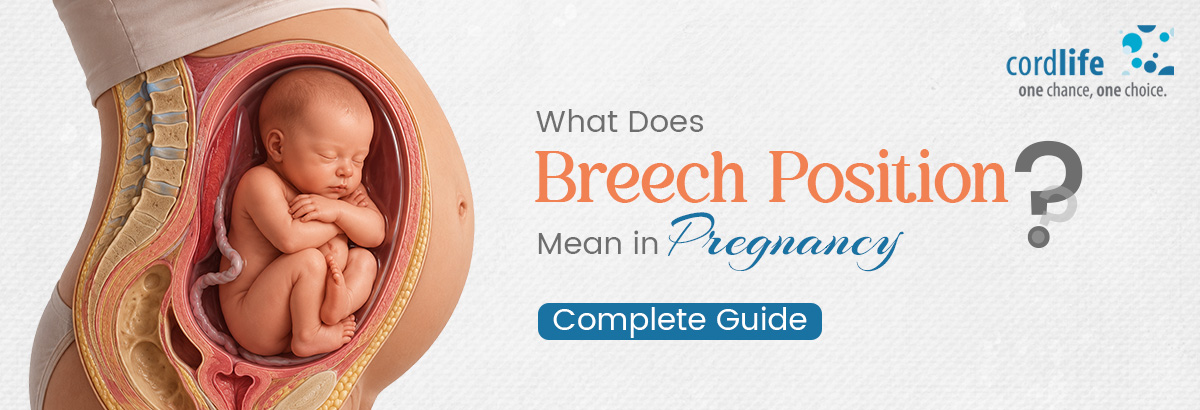
A baby has a breech position when it remains head-up, such as in a frank breech or footling breech presentation. The breech position in pregnancy is normal early on, but as a singleton pregnancy progresses to term, breech presentations become much less common. During early pregnancy, the baby has plenty of room to float, flip, somersault, kick, turn, and stretch. By weeks 34 to 36 of pregnancy, most babies naturally turn into the head-down position (cephalic presentation) as the space inside the uterus becomes more limited.
Each breech position is slightly different. Doctors classify the type of breech presentation based on the position of the baby’s legs relative to the torso.
Frank Breech
This is the most common breech position where the baby’s buttocks sit closest to the birth canal, while both legs extend upward with the feet near the head.
Complete Breech
The baby keeps its buttocks and feet relatively close to the birth canal in this position.
Footling Breech
A footling breech may be of two kinds – a single footling breech, where one of the baby’s feet hangs straight down, and the other is straight in the air; and a double footling breech where the baby’s feet are both hanging down. A double footling breech is often very serious and can put the umbilical cord at risk of being compressed.
Reasons Behind Breech Presentation
Mothers are often found wondering why their baby is in a breech position. One of the important things to realise is that having a breech baby has almost nothing to do with something the mother did or did not do. Generally, it’s a matter of physics and spatial relationship inside the womb. Multiple reasons may cause the baby from turning into head down position:
Polyhydramnios (excess amniotic fluid)
The baby may have a great deal of fluid and be flipping themselves back and forth, moving beyond head down to breech.
Oligohydramnios (lack of amniotic fluid)
In this case, the baby is tightly wedged, and it becomes physically hard for them to move into the head-down position.
Low-lying placenta
If the placenta implants in the lower part of the uterus, it may influence the foetal position by obstructing the baby’s head.
Multiple Pregnancy
If a mother is carrying twins, triplets, or more, the babies may not have enough room to flip into the head-down position.
Shape of the Uterus
An abnormal shape of the uterus or large benign fibroids can limit the space for a baby to turn around.
Immaturity
The baby breech position is common in premature deliveries, as most babies are not fully ready to flip head-down at that gestation.
How is a Breech Position Diagnosed?
The healthcare provider checks the baby’s position during the last few weeks of the third trimester. The following methods accurately confirm a breech presentation:
Leopold’s Manoeuvres
Healthcare providers place their hands on the mother’s abdomen to determine the foetal position. This age-old practice helps identify whether the baby is breech. Healthcare providers can detect the baby’s head, back, and feet within seconds.
Ultrasound
If doctors suspect a breech baby position, they can use a diagnostic ultrasound to clearly identify the baby’s exact position.
Pelvic Exam
At the beginning of labour, manual pressure within the pelvis may reveal which body part of the baby leads into the birth canal.
Measuring the foetal heart tone
Doctors measure the rate and position of the baby’s heartbeat using a handheld Doppler device. If doctors hear the heartbeat most clearly just below the mother’s belly button, the baby is most likely head-down.
Delivery Procedure of Breech Baby
When a mother reaches 37 weeks of pregnancy, discovering that the baby is still in a breech position can be concerning. Although the birth plan may need to change, the goal remains the same—a safe delivery for both mother and baby.
Here’s what happens if the baby is breech at 37 weeks. The doctor reviews the most recent ultrasound to determine the exact breech presentation, checks the amniotic fluid levels, and opts for the best-suited options.
External Cephalic Version (ECV)
If both mother and baby are healthy and have good amniotic fluid, the doctor might offer ECV. In this procedure, a trained obstetrician applies firm, guided physical pressure to the mother’s abdomen to manually roll the baby into a head-down position. The procedure is typically performed in a hospital setting where ultrasound tracking and fetal heart monitoring ensure safety.
C-section
If the doctor determines that the mother is not a suitable candidate for ECV, or if the baby does not turn, the doctor will usually schedule a planned C-section around week 39. Doctors often recommend a planned C-section as the safest delivery option for a breech pregnancy. It eliminates any risk of the baby’s head or umbilical cord getting stuck in the birth canal.
Conclusion
Learning that the baby has a breech presentation can feel stressful, but clear, accurate, and safe non-surgical and surgical procedures can help doctors plan a safe and positive birth experience